
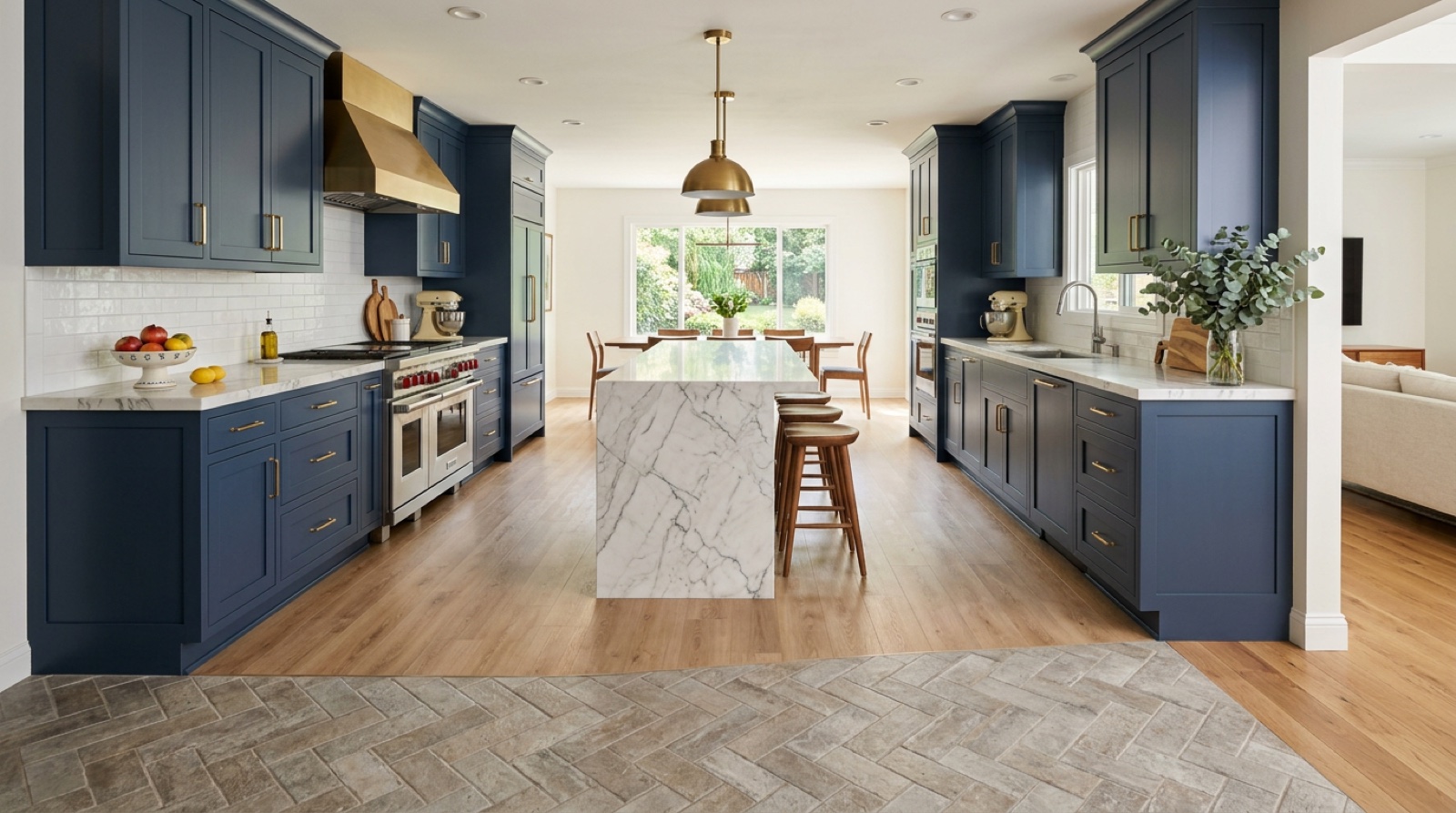
For most kitchens, the three flooring materials worth serious consideration are porcelain tile, luxury vinyl plank, and engineered hardwood. Everything else is either a compromise or a specialty choice.
Porcelain tile is the most durable. LVP is the most forgiving of spills and the easiest on a budget. Engineered hardwood delivers the best look and the strongest resale appeal.
Porcelain Tile: Maximum Durability, Least Comfort
Porcelain is fired denser than ceramic, which makes it harder, less porous, and far better suited to a floor that takes daily abuse. A properly installed porcelain floor will outlast the cabinets above it.
It is completely unbothered by water. Dishwasher leaks, a burst supply line under the sink, or a kid emptying a water bottle on the floor are non events for tile.
The trade offs are real, though. Tile is cold in January, hard on your knees and lower back, and unforgiving when you drop a wine glass or a stoneware bowl.
Grout is the other consideration. Modern epoxy and urethane grouts resist staining well, but standard cement grout in a busy kitchen will need periodic cleaning and eventual resealing.
When tile makes sense
- You have pets, kids, or heavy foot traffic through the kitchen
- Your kitchen opens onto a patio or garage entry that tracks in grit
- You are adding in floor heat, which solves the temperature complaint entirely
- You want the same material to run into a mudroom or laundry area
Luxury Vinyl Plank: The Practical Middle Ground
LVP has improved enormously in the last decade. The better rigid core products have realistic embossing, convincing wood grain variation, and wear layers thick enough to handle real traffic.
It is waterproof through the full thickness of the plank, not just on the surface. That matters in a room where the biggest flooring risk is a slow leak nobody notices for three weeks.
LVP is also warmer and softer underfoot than tile. If you cook most nights and spend real time standing at the counter, your feet will notice the difference.
The honest limitation is that LVP can dent under heavy point loads, like a refrigerator leg or a dropped cast iron skillet. It also cannot be refinished, so when the wear layer goes, the floor gets replaced.
Engineered Hardwood: Warmth and Resale Value
Engineered hardwood uses a real wood veneer over a plywood or composite core. That core is dimensionally stable, which is exactly what you want in Kansas.
Wichita swings from humid summers to bone dry winters with forced air heat running constantly. Solid hardwood reacts to that cycle by cupping and gapping, while engineered planks stay put.
It is the best looking of the three and the most attractive to buyers. In older Riverside and College Hill homes, engineered hardwood also lets you match or continue the flooring from adjacent living areas without a jarring transition.
Water is still the weak point. Standing water left overnight will damage the veneer and can delaminate the core.
Look for a wear layer of at least 3mm if you want the option to sand and refinish once down the road. Thinner veneers are cheaper but essentially disposable.
Side by Side Comparison
| Factor | Porcelain Tile | LVP | Engineered Hardwood |
|---|---|---|---|
| Installed cost per sq ft | $9 to $18 | $5 to $10 | $10 to $18 |
| Lifespan | 40+ years | 15 to 25 years | 25 to 40 years |
| Water resistance | Excellent | Excellent | Fair |
| Comfort underfoot | Poor | Good | Good |
| Refinishable | No | No | Yes, if veneer allows |
| Resale appeal | Good | Fair | Excellent |
Subfloor and Moisture Come First
The single biggest cause of flooring failure is not the material. It is the surface underneath it.
Tile requires a flat, stiff subfloor. Any deflection between joists will telegraph into cracked grout lines and eventually cracked tile, which is why most tile jobs need an underlayment or a decoupling membrane rather than going straight over plywood.
LVP is thin and rigid, so it reveals every dip and hump. A floor that is out of level by more than about 3/16 of an inch over ten feet needs leveling compound before a single plank goes down.
Concrete slabs need a moisture test before any wood product is installed. Plenty of Wichita area homes built on slab in Derby, Maize, and Goddard have enough vapor drive to ruin an engineered floor that was installed without a proper barrier.
If your kitchen sits over a basement or crawl space, check for humidity issues down there first. Solving a moisture problem after the finish floor is in costs several times what it costs to solve beforehand.
What Actually Holds Up in a Busy Kitchen
After a few years of real use, the floors that still look good share a few traits. They have texture rather than high gloss, mid tone color rather than very light or very dark, and visible grain or variation that hides crumbs and scuffs.
A dark, glossy floor shows every footprint and every speck of flour. A very light floor shows every drip of coffee.
Sequencing matters too. Running the flooring under the cabinets costs more material but makes future appliance swaps and any full kitchen renovation down the road much simpler.
Coordinate the floor with your other surfaces before ordering. Flooring, countertop selection, and cabinet finish all read together, and a sample that looks right in a showroom can look wrong under your own lighting.
Making the Call
If durability is the priority and you can live with hard, cold underfoot, choose porcelain tile. If you want waterproof performance at the lowest cost, choose LVP.
If you want the floor that looks best and holds value, choose engineered hardwood and accept that you will need to wipe up spills promptly.
Our team handles flooring installation for homeowners across Wichita, Andover, Bel Aire, Newton, and Valley Center, including the subfloor prep most quotes leave out. Reach out for a written estimate and we will walk your kitchen, check the subfloor, and give you real numbers for all three options.